
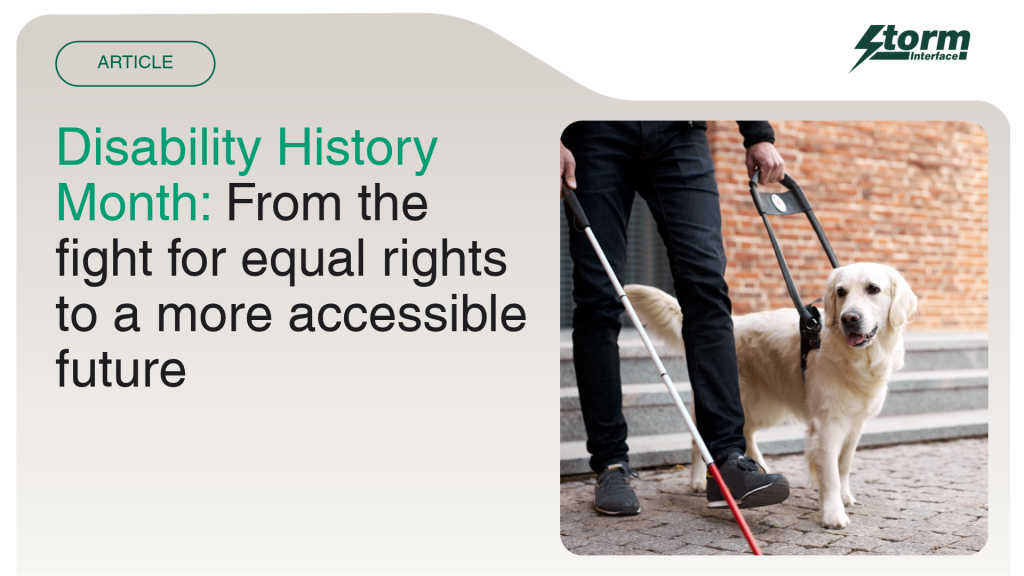
Disability rights have come a long way, but the fight for equality is far from over. From decades of activism and landmark legislation to the technology shaping how we access everyday services, Disability History Month is an opportunity to reflect on how far society has travelled – and how much further it needs to go.
Every day, millions of people interact with services that many of us take for granted. We withdraw money, buy tickets, check in for appointments, order food, make payments and access public information. Increasingly, these everyday activities take place through digital interfaces and self-service technology.
But what happens when the technology designed to make life easier creates another barrier?
For someone visually impaired, a touchscreen without audio guidance may be impossible to navigate independently. For a wheelchair user, a poorly positioned terminal can make a simple transaction inaccessible. For someone with a hearing impairment, instructions delivered exclusively through sound may exclude them from the experience altogether.
These are not simply technology problems. They are questions of equality, independence and participation.
UK Disability History Month provides an important opportunity to examine the social and political history behind these challenges. It reminds us that accessibility was not simply granted through changing attitudes or technological progress. It has been shaped by generations of disabled people, campaigners and organisations challenging exclusion and demanding equal rights.
In 2026, Disability History Month runs from 19 November to 19 December, under the theme “Disability, Politics and Democracy”. The theme highlights the relationship between disability, political representation and the ability to participate fully in society.
It also raises a question that remains relevant today: how democratic can a society be if some of its citizens cannot access the services, spaces and opportunities available to everyone else?
1. The history of disability rights and accessibility: From exclusion to equality
For much of modern history, disability was predominantly viewed through a medical or charitable lens. Disabled people were frequently treated as individuals who needed care, protection or institutional support, rather than as citizens entitled to the same rights and opportunities as everyone else.
This approach had profound consequences. Physical environments were designed without considering different mobility needs. Education and employment opportunities were restricted. Public services were often inaccessible, while disabled people had limited influence over the decisions affecting their lives.
However, the history of disability is not simply a history of exclusion. It is also a history of resistance, organisation and political action.
Following the Second World War, growing numbers of disabled people and their families began campaigning for better services, greater independence and recognition of their rights. In the United Kingdom, the Chronically Sick and Disabled Persons Act 1970, introduced by Alf Morris, was an important milestone. It placed duties on local authorities to provide a range of services for disabled people and helped bring disability issues further into the political mainstream.
During the 1970s and 1980s, disability activism became increasingly influential. Campaigners challenged the assumption that disability was solely an individual medical problem. Instead, they argued that society itself created many of the barriers disabled people experienced.
This became known as the social model of disability.
The distinction is important. A person’s impairment does not automatically prevent them from participating in society. Rather, inaccessible buildings, poorly designed services, discriminatory attitudes and inadequate technology can create disabling barriers.
A person using a wheelchair, for example, may be perfectly able to enter a building, but an inaccessible entrance prevents them from doing so. Similarly, a visually impaired person may be fully capable of completing a self-service transaction, but a touchscreen that provides no accessible alternative prevents independent use.
The responsibility therefore shifts: instead of expecting disabled people to adapt to an inaccessible world, society must address the barriers it creates.
Activism that changed legislation
The political history of disability rights is marked by campaigns that transformed public awareness and influenced legislation.
In the United States, the 1977 Section 504 sit-ins were a defining moment. Disabled activists occupied federal buildings to demand the implementation of regulations protecting people with disabilities from discrimination in federally funded programmes. The demonstrations helped secure enforcement of Section 504 of the Rehabilitation Act of 1973, establishing an important foundation for future civil rights protections.
That momentum contributed to the wider movement that led to the Americans with Disabilities Act (ADA) of 1990. Signed into law on 26 July 1990, the ADA established broad civil rights protections for people with disabilities across employment, state and local government services, public accommodations, commercial facilities and telecommunications.
In the UK, campaigners also used demonstrations and direct action to challenge discrimination. The Disability Discrimination Act 1995 represented a major legislative development, making disability discrimination unlawful in a number of important areas, including employment and the provision of goods and services.
The introduction of the Equality Act 2010 subsequently brought together and strengthened much of the UK’s equality legislation, including protections relating to disability. It also established duties around reasonable adjustments, requiring organisations to take appropriate steps to remove substantial disadvantages experienced by disabled people.
A further landmark came in 2006, when the United Nations adopted the Convention on the Rights of Persons with Disabilities (UNCRPD). The Convention entered into force in 2008 and helped establish disability rights firmly within the international human rights framework.
Its underlying principle is clear: disabled people must be able to enjoy human rights and fundamental freedoms on an equal basis with others.
Article 9 addresses accessibility, including access to buildings, transport, information, communications and services open to the public. Article 19 recognises the right to live independently and be included in the community.
Together, these developments represent a significant change in how disability is understood politically and socially. Accessibility is no longer simply a matter of goodwill. It is a fundamental part of equality, human rights and participation.
Yet legislation alone cannot guarantee an inclusive society. Rights must translate into real experiences, and that means ensuring that everyday environments, services and technologies work for everyone.
2. The importance of independent access to public services
Independence is one of the most important principles underpinning disability rights.
Being able to access a service without relying on another person is not simply a matter of convenience. It is closely connected to dignity, privacy, autonomy and personal freedom.
Consider the everyday experience of using an ATM, purchasing a train ticket, checking in for a medical appointment or ordering a meal. For many people, these activities require little thought. They approach the machine, follow the instructions and complete the transaction.
For someone with a disability, however, the same experience can be very different.
A visually impaired customer may be unable to identify the options displayed on a screen. A person with limited dexterity may struggle to operate a touchscreen. Someone with a cognitive disability may find an inconsistent interface difficult to understand. A person with a hearing impairment may miss instructions delivered through audio alone.
When accessible alternatives are missing, the consequences extend beyond inconvenience.
People may have to disclose personal information to a member of staff or another customer. They may need assistance with financial transactions, appointments or purchases that others can complete privately. In some cases, they may abandon the transaction altogether.
This is why independent access matters.
It gives people greater control over their own decisions and allows them to participate in everyday life on more equal terms. It also challenges the assumption that assistance should be the default solution whenever a service has not been designed inclusively.
The political and legislative responsibility
The principle of independent access is reflected in international and national legislation.
The UN Convention on the Rights of Persons with Disabilities recognises accessibility as a requirement for independent living and full participation in society.
In the United States, the ADA establishes obligations for public entities and businesses serving the public. Its effective communication requirements are particularly relevant to technology-based services. Depending on the circumstances, organisations may need to provide auxiliary aids and services, including screen readers, audio information and other communication support, to ensure that people with communication disabilities can access services effectively.
In Europe, the European Accessibility Act (EAA), Directive (EU) 2019/882, represents another major step towards improving access to everyday products and services.
The legislation applies to a defined range of products and services, including certain self-service terminals such as payment terminals, ATMs, ticketing machines, check-in machines and interactive information terminals. Its requirements have applied from 28 June 2025, subject to the Directive’s scope and transitional provisions.
For these technologies, accessibility is not limited to making information visible on a screen. Requirements include features such as text-to-speech, support for personal headsets, adequate contrast, tactilely discernible keys and controls where available, and the ability to extend time limits where timed responses are required.
The wider message is significant: digital convenience must not come at the expense of equal access.
For businesses and public service providers, this means considering accessibility throughout the customer journey, rather than treating it as an additional feature to be addressed only when a problem is reported.
3. How accessible self-service technology can remove barriers
Self-service technology has transformed the way organisations deliver services.
Retailers use self-checkout systems to manage queues and provide faster transactions. Airports rely on automated check-in and boarding processes. Restaurants increasingly offer ordering kiosks, while transport operators use ticket machines and information terminals to support passengers.
These systems can improve efficiency, increase convenience and give customers greater control over how they interact with a service.
However, their benefits are only meaningful if people can actually use them.
A self-service terminal that excludes a proportion of its intended users cannot be considered a fully successful self-service solution.
Accessibility therefore needs to be considered as part of the entire interaction, from locating the kiosk to completing the transaction and receiving confirmation.
Moving beyond the touchscreen
Touchscreens have become the dominant interface for modern kiosks, but they are not universally accessible.
For people who are visually impaired, a screen without audio support can make it impossible to identify menus, buttons or transaction information. For people with mobility or dexterity limitations, small interactive targets or complex gestures can create difficulties.
An accessible kiosk should offer alternative ways to interact.
This may include:
- Tactile controls: Physical keys that users can locate and operate through touch.
- Audio guidance: Spoken instructions that explain on-screen content and guide users through each stage of a transaction.
- Accessible software: Screen-reading technology, clear navigation, suitable text sizes and sufficient colour contrast.
- Flexible interaction: Adequate time to complete tasks, accessible controls and alternatives to interactions that rely exclusively on touch, sight or hearing.
- Thoughtful physical design: Appropriate screen positioning, reach ranges and space for wheelchair users.
The key is to make these features work together.
Providing audio instructions is not enough if a user cannot activate them independently. Tactile controls are not sufficient if the software does not communicate the information required to complete the transaction. Similarly, accessible software cannot compensate for a terminal that is physically impossible to reach.
Accessibility is a system, not a collection of disconnected features.
Technology that supports independence
This is where accessible hardware and software can make a practical difference.
Solutions such as tactile keypads, audio navigation and screen-reading software provide alternative ways for people to interact with self-service terminals.
For example, an accessible audio interface can guide a visually impaired customer through the options displayed on the screen. Tactile controls allow users to navigate without relying entirely on visual information, while private headphone connections can help protect the confidentiality of the transaction.
These technologies can support greater independence in environments such as retail stores, restaurants, airports, banks and transport hubs.
Importantly, accessibility also benefits people beyond those with permanent disabilities. Older customers, people with temporary injuries, individuals with limited digital confidence and anyone using a kiosk in a difficult environment may benefit from clearer instructions, alternative interaction methods and more intuitive design.
This is the wider value of inclusive technology: when products are designed to accommodate a broader range of people, the experience often improves for everyone.
4. Why accessibility should be built into new kiosks – and retrofitted into existing ones
One of the most important lessons from the history of accessibility is that designing for inclusion from the beginning is far more effective than attempting to remove barriers after they have become established.
The same principle applies to self-service technology.
As retailers, transport operators and service providers continue investing in automated systems, accessibility should be part of the original specification.
It should influence the choice of hardware, software, physical layout, user interface and payment technology. It should also be considered during procurement, development, testing and deployment.
Waiting until a kiosk is installed before considering accessibility can lead to additional costs, technical limitations and unnecessary redesign.
Designing accessibility in from the start
For manufacturers and operators developing new kiosks, accessibility should be treated as a core design requirement.
That means involving accessibility specialists and disabled users during development, testing complete customer journeys and ensuring that different interaction methods work together.
It also means considering the needs of people with different disabilities rather than designing around a single user profile.
A genuinely accessible kiosk should allow users to locate the terminal, understand how to begin, navigate the interface, make selections, correct mistakes and complete the transaction as independently as possible.
This is particularly important as the European Accessibility Act and other regulatory frameworks place greater emphasis on accessible products and services.
The EAA does not apply indiscriminately to every kiosk, and its requirements depend on the product or service falling within its defined scope. However, for organisations operating in the relevant markets and sectors, it makes accessibility an increasingly important consideration when developing and placing new self-service terminals on the market.
In the United States, the ADA‘s wider obligations concerning equal access and effective communication similarly reinforce the need to consider how customers with disabilities interact with technology-based services.
Retrofitting: Making existing kiosks more accessible
But what about organisations that already have hundreds or thousands of kiosks installed?
Replacing an entire kiosk estate may be financially unrealistic, operationally disruptive and environmentally wasteful.
This is where retrofitting offers a practical alternative.
Retrofitting allows organisations to introduce accessibility features into existing machines, potentially extending the useful life of the equipment while improving the experience for customers with disabilities.
Depending on the kiosk design and software architecture, this may involve adding externally mounted tactile keypads, audio guidance, accessible screen-reading software or other assistive technology.
For example, Storm Interface’s Externally Mounted AudioNav™ has been designed to support accessibility upgrades to existing kiosks. Its external mounting approach can make it suitable for retrofit projects where redesigning the kiosk enclosure is not practical.
Retrofitting can offer several advantages:
- Reduced investment: Improving existing equipment may be more cost-effective than replacing complete kiosk systems.
- Less disruption: Accessibility upgrades can often be planned around existing installations and operational requirements.
- Extended equipment life: Retrofitting can help organisations improve the usefulness of existing assets.
- Faster improvements: Suitable upgrades can provide a practical route towards a more inclusive customer experience.
- Greater flexibility: Organisations can assess their existing estate and prioritise upgrades according to their needs and available resources.
It is important to distinguish the business case for retrofitting from the precise legal obligations applying to existing equipment. The EAA includes transitional provisions for certain self-service terminals already in lawful use before 28 June 2025. These may continue to be used until the end of their economically useful life, subject to a maximum of 20 years after they entered into use, where the relevant national provisions apply.
That does not remove the wider case for improving accessibility. Organisations should assess their equipment, services and legal responsibilities individually rather than assuming that every existing kiosk is either automatically exempt or automatically required to be replaced.
Accessibility requires an ongoing commitment
Whether an organisation is developing a new kiosk or upgrading an existing installation, accessibility should not end when the equipment is switched on.
Software updates, changes to payment systems, new transaction flows and modifications to physical hardware can all affect accessibility.
Regular testing is therefore essential. Organisations should involve disabled users, gather feedback from customers and staff, and assess the complete journey rather than checking individual components in isolation.
Accessibility is not a one-off project. It is an ongoing responsibility.
Looking forward: Making independence part of everyday design
Disability History Month is an opportunity to recognise the people who challenged exclusion, changed legislation and helped reshape society’s understanding of disability.
Their work has demonstrated that accessibility is not a privilege, a charitable gesture or an optional enhancement. It is fundamental to equal participation.
The ADA, the European Accessibility Act and the UN Convention on the Rights of Persons with Disabilities represent important milestones in that journey. But their impact ultimately depends on how organisations translate legal principles into everyday experiences.
For the self-service industry, that responsibility is becoming increasingly visible.
As kiosks become a standard part of retail, hospitality, banking and public services, organisations must ask whether their technology is genuinely accessible – not simply whether it works for the majority of customers.
Can a visually impaired customer complete a transaction independently? Can someone with limited mobility comfortably reach and operate the controls? Can a person who cannot hear audio instructions access the same information through another method? Can customers complete their journey privately, confidently and without unnecessary assistance?
These are the questions that should shape the future of self-service.
At Storm Interface, we believe accessibility should be considered from the very beginning of every kiosk project. Through accessible hardware, software, retrofit solutions and consultancy, we work with organisations to help make self-service more inclusive.
Because the real measure of self-service is not simply how many transactions a kiosk can process.
It is whether everyone has the opportunity to complete one.