
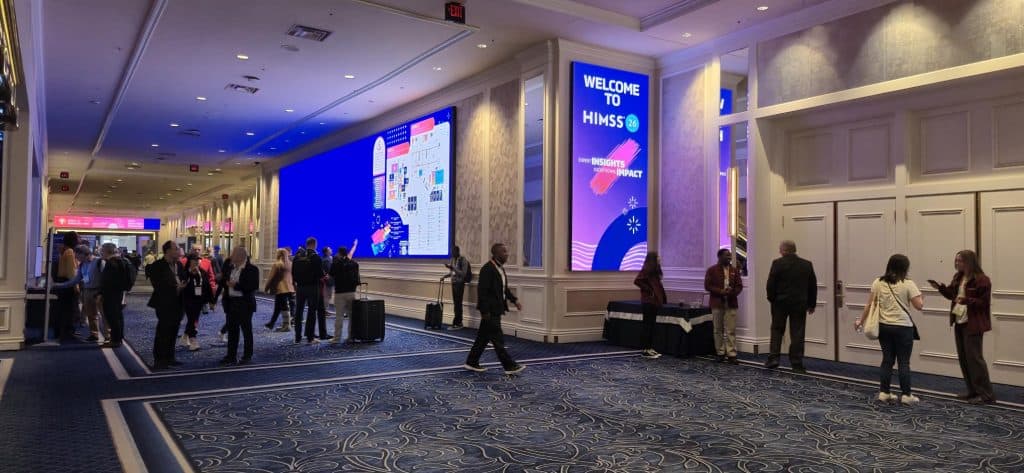
From 9-12 March 2026, Storm Interface was proud to take part in HIMSS Global Health Conference & Exhibition 2026 2026 in Las Vegas, where we joined healthcare leaders, technology innovators and accessibility advocates to discuss the future of digital healthcare. Accessible self-service kiosks in healthcare should not be an afterthought but an integral part of the offer.
Hosted on the KMA booth (3461), we showcased how accessibility must be central to the next generation of healthcare self-service technology.
The growing role of self-service kiosks in healthcare
Self-service kiosks are now widely used in hospitals, clinics, care facilities and pharmacies. Patients rely on them to check in for appointments, update personal information, confirm insurance details, make payments and access wayfinding assistance.
These systems help reduce queues, streamline operations and allow healthcare staff to focus on patient care. However, as reliance on self-service technologies grows, so does the responsibility to ensure that these digital touchpoints are accessible to everyone.
Healthcare environments serve people of all ages and abilities. Many patients may be elderly, temporarily injured, neurodivergent or living with visual, auditory or motor impairments. When a kiosk is not accessible, it does more than create inconvenience. It can create exclusion at a moment when independence and dignity matter most. Accessible self-service kiosks in healthcare should become a priority.

A real-world accessibility challenge
Consider a visually impaired patient arriving alone at a busy hospital for an important appointment. Upon arrival, the reception area directs patients to check in using a touchscreen kiosk.
However, the screen is glossy and filled with glare, and the text is small. In addition, there is no tactile reference point, no headphone jack, and no audio guidance. As a result, the interface relies entirely on sight, meaning the patient cannot independently locate the start button, read the instructions, or confirm their selections.
Consequently, they must ask a stranger for help. This not only risks exposing sensitive medical information but also undermines confidence and independence.
In a healthcare environment, this should never be the case. Accessibility is not an optional enhancement; rather, it is a fundamental requirement for equitable care.
The impact of Section 504
At HIMSS, conversations frequently returned to the recent update to Section 504 of the Rehabilitation Act, which strengthens expectations around accessible digital services and technologies used by healthcare organisations receiving federal funding.
The updated rule reinforces that digital health tools, including self-service kiosks, must be accessible to people with disabilities.
For many organisations, Accessible self-service kiosks in healthcare represents not only a compliance obligation but also an opportunity to lead in inclusive design.

Storm Interface at HIMSS 2026
During the exhibition, Storm Interface demonstrated how AudioNav provides a practical and proven solution for accessible healthcare kiosks.
AudioNav is a tactile and audio navigation interface that enables blind and partially sighted users, as well as many others who benefit from multi-sensory interaction, to independently use self-service systems.
With tactile navigation keys and private audio output via headphone connectivity, AudioNav allows patients to navigate menus confidently and securely.
By integrating accessible hardware into healthcare kiosks, providers can:
- Support compliance with Section 504 and broader accessibility standards
- Protect patient privacy during digital interactions
- Enhance independence and dignity for patients
- Future proof digital infrastructure
Throughout the event, visitors to booth 3461 had the opportunity to experience AudioNav in action and explore how accessibility can be embedded from the outset of any healthcare digital project.

Designing healthcare technology for everyone: Moving towards accessible self-service kiosks in healthcare
The discussions at HIMSS reinforced a clear message: advancing healthcare technology must also mean advancing accessibility. Self service in its many forms is here to stay, from patient check in kiosks to wayfinding systems and even the emerging concept of the hospital room of the future.
In this new model, patients are increasingly expected to interact with digital systems to manage aspects of their care, including accepting remote consultations via in room screens and connected devices. Yet in many cases, the accessibility of these interactions has not been fully considered.
The real question is not whether these technologies will be adopted, but whether they will be designed for some or designed for everyone.
Storm Interface believes that accessible design is not simply a feature. It is a responsibility, and one that the healthcare sector is uniquely positioned to lead.