
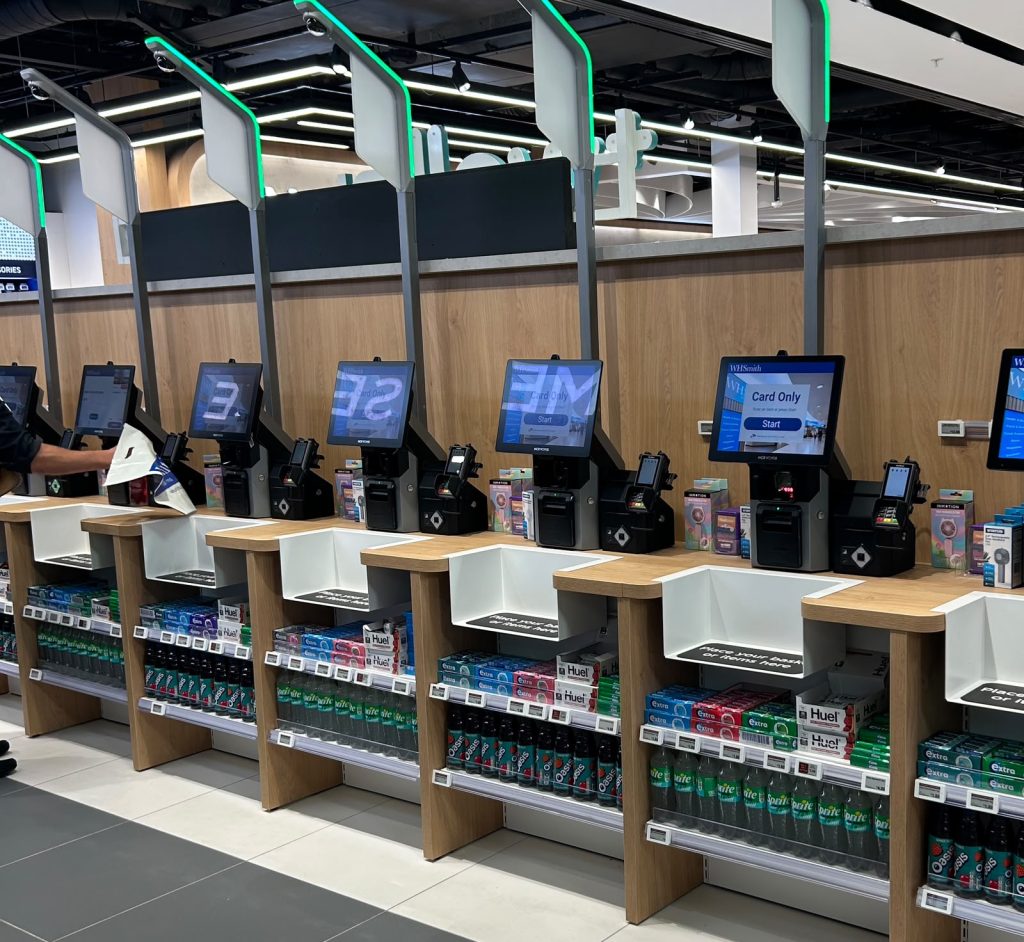
A blind or low-vision customer walks into a fast-food restaurant and finds that the ordering kiosks are inaccessible. The staff are busy, nobody is available to help, so the customer leaves.
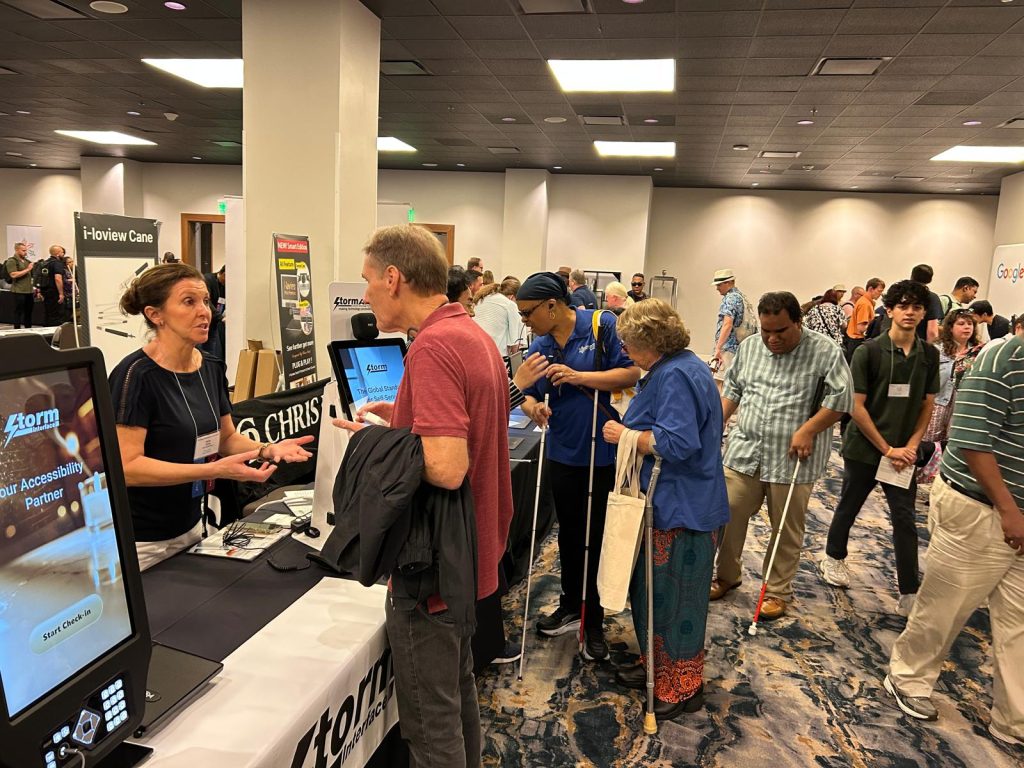
“I didn’t end up ordering my burger from that business,” one person told us at the National Federation of the Blind Convention. “The members of staff were too busy to help me,” reflected Nicky Shaw, our US Operations Manager.
The sale disappears quietly. There is no failed payment to investigate, no abandoned basket in the analytics and no technical fault visible to the restaurant team because the kiosk appears to be working.
But for that customer, it wasn’t.
Stories like this are easy for large organisations to miss because they usually arrive one at a time. Someone mentions a problem to a store manager. Another person gives up and goes elsewhere. A third decides never to use the kiosk again.
Each incident looks isolated, but together, they reveal something much larger: self-service is failing customers in ways that conventional performance data does not capture.
We first confronted the scale of that gap when we spent a week speaking to thousands of blind people and discovered the metric most self-service programmes are missing. The conversations at the National Federation of the Blind convention made one thing clear: Organisations are collecting data about their machines while missing crucial evidence from the people expected to use them.
Storm Interface wants to change that.
Share your Self-Service Experience because Storm Interface collects real accounts from disabled people using kiosks, checkouts, payment terminals and other self-service systems. We want to understand what works, where journeys fail and what organisations could change, then turn those experiences into a clear business case for action.
Self-service is now part of everyday life: We use it to order food, pay for shopping, collect prescriptions, check in for medical appointments, buy tickets and register at airports. Voting, banking and parking increasingly involve some form of unattended technology.
That makes the quality of the experience important, and it also makes failures harder to avoid. As Matthijs Verhagen, our resident EAA Compliance Specialist, points out:
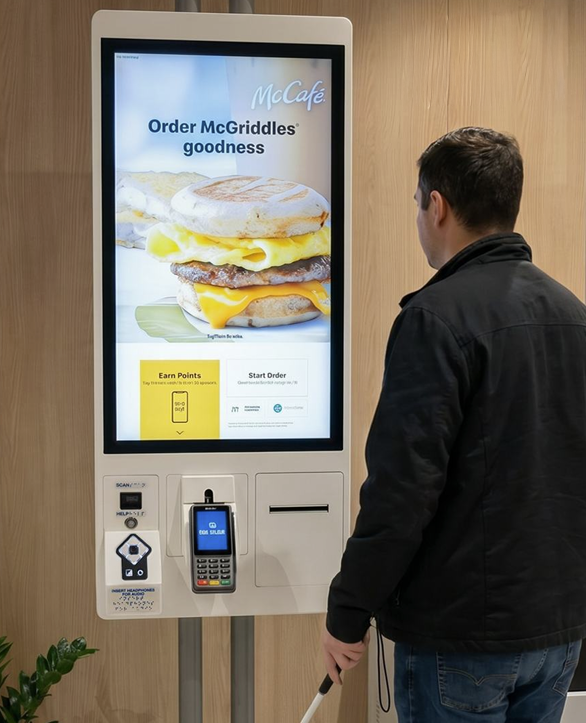
“An accessible self-service journey contains several connected steps. The customer must be able to find the kiosk, identify that it has accessible controls, start the audio, navigate the interface, understand the options, make a payment and confirm that the transaction has been completed.
Every step has to work.
A kiosk may have tactile controls but no obvious way for a blind person to locate them. It may have a headphone socket hidden beneath the screen without a tactile or Braille indicator. The screen reader may start correctly and then stop halfway through the transaction. A timeout designed around visual navigation may expire before the audio instructions have finished.
The payment terminal can create another barrier at the final moment.”
Nicky added, “At the NFB Convention, more than one blind person told us they had been forced to hand over a debit or credit card, and in some cases disclose a PIN, because the payment terminal was inaccessible.
I was gobsmacked. We had more than one person tell us they’d actually had to give somebody their debit or credit card or even their PIN number at the payment terminal!”
These customers had successfully reached the point at which they were ready to pay. The business had secured their attention, their choice and their intention to purchase. Then the technology placed them in an unnecessarily vulnerable position.
As Nicky put it:
“You may as well just open your wallet and say, ‘Take what you want.’”
That is the human cost of a broken journey. It is also a security problem, a customer experience problem and a commercial problem for businesses.
Many organisations assume the presence of a staff member makes an inaccessible kiosk acceptable, but that assumption rarely survives contact with a busy store, hospital or transport hub. Assistance does not restore confidence or independence
The employee responsible for several self-checkouts may already be approving an age-restricted purchase or fixing a scanning error. A receptionist may be helping another patient, dealing with paperwork or away from the desk. At an unattended parking machine or vending unit, there may be nobody to ask.
The customer waits, the transaction takes longer, and a private task becomes public. The organisation pays too: staff must step away from other work to complete a transaction the kiosk was meant to handle. Queues grow, throughput falls, and operating savings disappear. The customer loses time, privacy and independence; The company adds cost and friction to a journey designed to reduce both.
Feedback gathered by Storm Interface repeatedly returns to the same issue: People do not want to place themselves in a vulnerable position simply to complete an ordinary transaction.
“We have heard this directly while speaking with blind and visually impaired self-service users,” said Nicky,
“The question they ask is entirely reasonable: “Why should I put myself in the position of being vulnerable and ask for help? I would like to be completely independent when I’m doing a transaction or ordering my food.”
Independence is the point of self-service. When a customer needs an employee to operate the technology, the system has failed to deliver the experience it was bought to provide.
The problems organisations cannot see are costing digital transformation billions.
A kiosk without power is an obvious failure. Staff can see the blank screen. Every customer encounters the same problem. Someone reports it, and the business fixes it.
Accessibility faults are different.
If the audio does not start when a blind customer connects headphones, most people walking past will never know. The kiosk continues processing transactions. Its uptime figures remain healthy. From the organisation’s perspective, nothing appears to be wrong.
The person affected may tell a member of staff, but that information has a difficult journey of its own. A comment made in one restaurant, hospital or airport may never reach the accessibility team, software provider, kiosk manufacturer or hardware supplier capable of resolving it.
This creates a dangerous gap between reported performance and lived experience.
Organisations can see how many transactions a kiosk completes. They struggle to see the customer who could not find the accessible unit, the person who abandoned the journey when the audio failed or the blind customer who avoided the machine because a previous experience had gone badly.
In The missing metric costing digital transformation billions, we argued that organisations should measure how many customers can complete a journey easily and independently. Completed transactions alone cannot answer that question because they exclude the people who required assistance, abandoned the process or avoided self-service altogether.
Those missing experiences matter. They can show where software needs attention, where hardware has been installed poorly, where staff need better guidance and where a small design decision is causing the same failure across hundreds of locations.
Without that evidence, an organisation can report strong kiosk performance while customers continue walking away.
Good experiences matter too
This campaign is not a catalogue of complaints.
We also want to know where self-service works well and why, and celebrate that.
At the National Federation of the Blind Convention, some attendees were surprised to learn that accessible kiosk technology was already available in businesses they used. Storm Interface has worked with leading global brands including McDonald’s and Taco Bell, yet visually impaired customers do not always know which locations provide accessible self-service or how to identify it when they arrive.
That communication gap wastes a lot of good work.
One of the most common questions the team heard from blind users was simple:
“How do I know, if I walk into a fast-food restaurant, coffee shop or airport, whether there is actually an accessible kiosk?”
A business may have invested in accessible controls, tested the software and created a journey that works, but if the customer cannot find the kiosk or does not know it is accessible, the investment sits unused.
Positive feedback can reveal the small details that make the difference. Perhaps the controls were easy to locate. The audio started automatically. Instructions were clear. The customer had enough time to navigate each screen. The payment process remained private.
Those details can be repeated.
Good examples also give organisations practical evidence. They show how accessibility performs in the real world and provide a model that designers, manufacturers and operators can apply elsewhere.
Turning individual accounts into evidence for change.
Storm Interface has launched the Share Your Self-Service Experience page to give users one place to record what happened while the details are still fresh.
We want to know:
- Where was the self-service system?
- What were you trying to do?
- Could you find the accessible controls?
- What was the first sign that the experience would work or fail?
- Did the audio and navigation continue throughout the journey?
- Could you complete the transaction privately and without help?
- What worked particularly well?
- What would have made the experience accessible?
No detail is too small. A headphone socket without sound may point to a software fault, a hardware problem or an installation issue. An accessible kiosk that is consistently difficult to find may reveal a problem with placement or signage. Several reports concerning the same organisation, location or stage of the journey can expose a pattern that no single complaint would reveal.
What happens to the data?
We are collecting these experiences to find recurring problems, understand what causes them and get that evidence to the people capable of making changes.
Individual submissions will be analysed as part of a wider body of anonymised data. We may find that several users have reported failed audio at the same location, that accessible kiosks are routinely difficult to identify or that one stage of a payment journey repeatedly forces people to ask for help.
Those patterns give us something concrete to investigate.
Some findings may lead directly to changes in Storm’s products or guidance. Others will need to be raised with software developers, kiosk manufacturers, payment providers or the organisations operating the machines. Where a business has created an experience that works particularly well, we can examine why and help others learn from it.
As Matthijs explained:
“Some of those problems we’ll be able to act on ourselves. Some will sit with the software team, the kiosk manufacturer or the organisation running the machine. Either way, we’ll make sure the feedback is directed to the people who can drive change.”
Anyone submitting an experience can choose whether they would like Storm Interface to contact them for more information. Personal details and individual accounts will not be published alongside someone’s identity without their permission.
We also want the evidence to travel back in the other direction. People are giving us their time and their experiences, so they should be able to see what that contribution achieves. As the body of evidence grows, we intend to share the patterns we uncover, the progress made with businesses and examples of changes prompted by user feedback.
The purpose is straightforward: collect experiences that are currently scattered across stores, airports, hospitals and other locations, turn them into usable evidence, and keep that evidence moving until it reaches someone who can act on it.
Help us show what accessible self-service looks like
For nearly four decades, Storm Interface has designed controls for demanding public and industrial environments. Over time, conversations with blind users, accessibility organisations, the Royal National Institute of Blind People and the National Federation of the Blind have shaped much more than our product range; they have changed how we think about self-service itself.
Accessible hardware is part of the answer, but the whole journey determines whether someone can act independently.
The people using these systems know where the barriers are. They know when an experience has been designed properly, and their accounts can help businesses understand the difference.
If you have recently used a self-service kiosk, checkout, payment terminal or vending machine, tell us what happened. Tell us what failed, what worked and what would have changed the experience.
Share Your Self-Service Experience
A complaint made at a counter can disappear; a body of evidence is much harder to ignore.
One story helps; hundreds make the case for accessible self-service.