
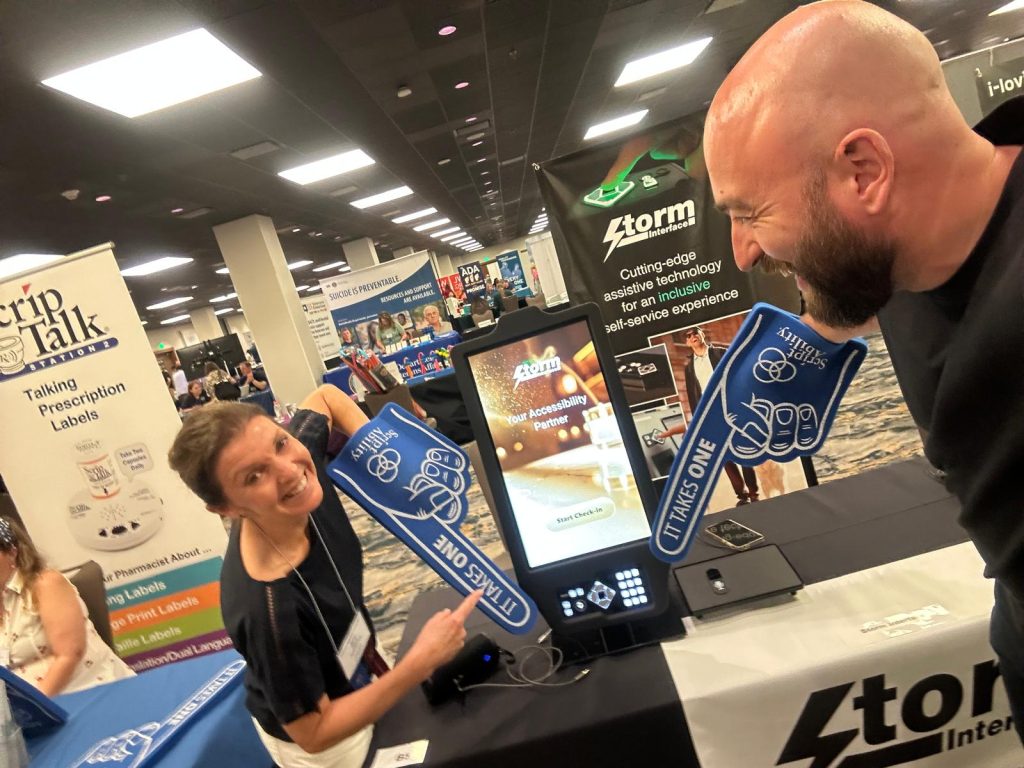
Nicky Shaw and Matthijs Verhagen from Storm Interface share their reflections from the National Federation of the Blind Convention.
We spent five days at the National Federation of the Blind Convention in Austin, Texas, speaking with thousands of people who rely on self-service technology every day.
As the largest gathering of blind people in the world, we expected to spend the week talking about accessible technology. Instead, we discovered something much bigger.
Most organisations are measuring the wrong thing.
Businesses celebrate self-service because it processes transactions faster, reduces labour costs and improves operational efficiency. Dashboards report transaction volumes, queue times, completion rates and cost savings.
Customers measure success very differently.
They ask one simple question:
“Can I do this easily and on my own?”
If the answer is no, every other KPI becomes secondary and somewhere between those two perspectives lies one of the biggest missing metric in digital transformation.
As Nicky Shaw, our US Operations Manager, reflected:
“Accessibility and great user experience go hand in hand because it’s fundamentally about operational performance.”
That became impossible to ignore throughout the week as we listened to people describe how inaccessible technology makes them feel. They used words like:
Frustrated. Embarrassed. Dependent. Invisible.
The irony is that almost every organisation we work with tells us customer experience is a strategic priority. Across retail, healthcare, transport, financial services, travel, education and corporate environments, businesses invest billions in digital transformation. They redesign websites, launch apps, deploy self-service kiosks and introduce AI to make interactions faster, simpler and more efficient.
Yet very few measure whether customers are able to complete the journey independently.
That should concern every organisation investing in self-service.
People aren’t asking for special treatment. They aren’t asking for someone else to complete the task for them. They simply want to order lunch, check into a hotel, buy a train ticket or pay for their shopping in the same way everyone else does. Independently.
Too often, accessibility is still treated as the final task on a project plan. We hear things like:
“We’ll add it later.”
“We’ll deal with it if someone complains.”
“We need to get the product live first.”
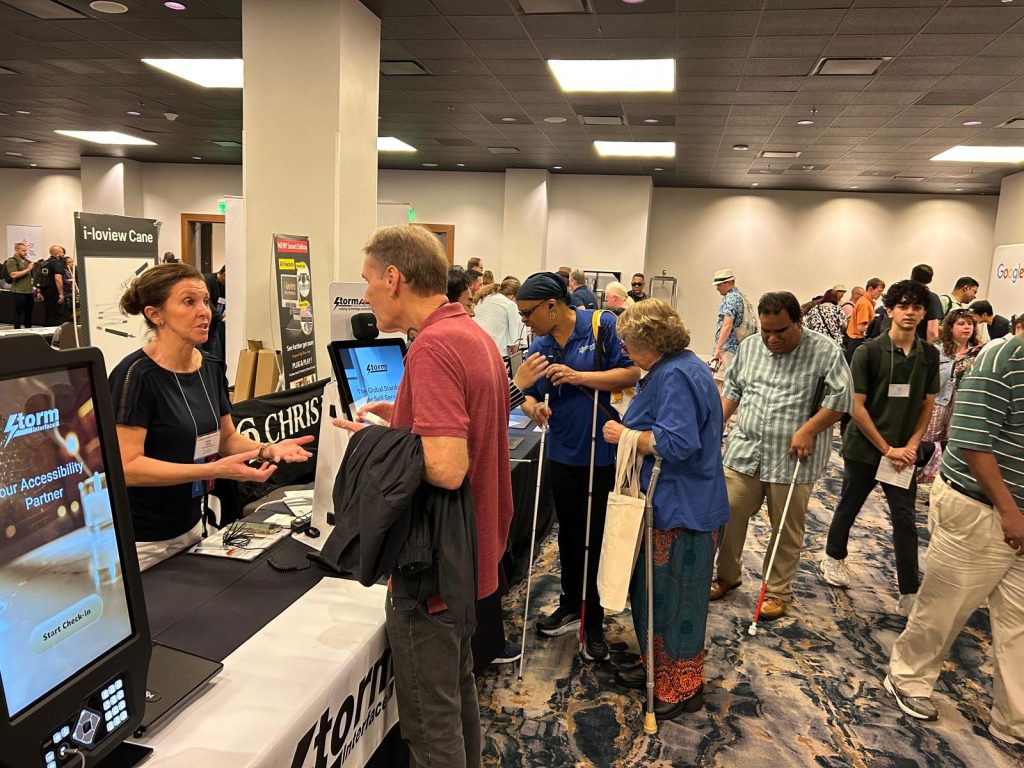
Nicky Shaws at the Storm Interface booth during the 2026 NFB Convention.
“Imagine applying that thinking to cybersecurity, payment security or system reliability. If people can’t use what you’ve built, it hasn’t succeeded.” Said Matthijs Verhagen, our resident EAA Compliance Specialist.
Nicky added, “Accessibility deserves the same level of attention because the outcome is the same: if customers cannot use the technology, the technology has failed.”
The commercial implications are far greater than many organisations realise because every inaccessible interaction has a cost.
Every time a customer abandons a kiosk, waits for assistance or decides not to come back, the promised return on that digital investment begins to erode.
There is also another cost that rarely appears on a dashboard.
Every inaccessible interaction turns an everyday transaction into a moment of frustration, embarrassment and dependence. It chips away at confidence, and it teaches people not to expect independence.
As Nicky put it:
“Organisations rarely lose customers because of the technology. They lose them because the experience fails to deliver the independence, dignity and confidence it promised.”
“Yes, organisations often celebrate self-service because it reduces labour costs and allows colleagues to focus on higher-value work. That’s exactly what good self-service should achieve but every time a member of staff must leave what they were doing to help a customer complete a transaction, the economics begin to change.
The kiosk still records a successful transaction and the KPI dashboard still reports another completed journey but the organisation has effectively paid for both a self-service solution and a member of staff to deliver the same service – that isn’t operational efficiency; it’s hidden operational cost.” said Matthijs.
Nicky highlighted:
“One point that came up repeatedly throughout the convention and surprised me was that many people had no idea accessible self-service already existed. Imagine that, expectations have become so low that people simply assume self-service wasn’t designed for them! That should concern every organisation, but it also represents an enormous opportunity.
As self-service becomes the default way customers interact with businesses, organisations that design genuinely inclusive experiences will continue to differentiate themselves, build stronger customer loyalty and set a new standard for customer experience.”
Perhaps the most surprising conversation of the week wasn’t about technology at all, it was about feedback.
Where do I go to report inaccessible self-service?
The honest answer is that most of the time, they don’t bother to report it.
They don’t fill in complaint forms or write formal letters.
They simply stop trying and then they start to avoid that supermarket, choose another restaurant, ask a member of staff instead and tell friends and family. The organisation loses another customer without ever understanding why.
Businesses often assume that no complaints mean no problem but silence often means people have stopped expecting the technology to work.
As Nicky observed:
“Far too many attendees had no idea that some organisations have already invested in accessible self-service. Organisations investing in accessible technology deserve recognition, and customers deserve to know where those experiences exist.”
That conversation led us to a simple idea.
If organisations genuinely want to improve customer experience, they need to understand how people experience self-service in the real world—not in usability labs or carefully controlled demonstrations, but in supermarkets, hospitals, airports, hotels and restaurants where these systems are used every day.
So we’ve created a platform where anyone can share their self-service experience.
Good or bad.
- Tell us where it happened.
- Tell us what worked.
- Tell us what didn’t.
- Upload a photo or short video if you can.
Every submission is reviewed by our accessibility specialists. Where appropriate, we’ll contact the organisation involved, explain the issue, share practical recommendations and encourage improvements. We also use anonymised insights to identify recurring accessibility challenges across industries.
Every submission helps organisations understand where they’re creating independence and where they’re unintentionally creating friction.
After spending a week listening rather than talking, one thing became abundantly clear: Customer expectations around self-service are changing.
Every year, organisations ask customers to do more for themselves – to check themselves in, order for themselves, pay for themselves and solve problems for themselves.
“If self-service is becoming the front door to modern organisations, accessibility is becoming the standard by which customer experience will be judged.” said Nicky.
As Matt reflected:
“I always leave the convention feeling motivated to keep pushing for 100% accessible self-service. Having spent these last few days watching the many ways in which people with sight impairments struggle with an inaccessible world, there’s no way inaccessibility can be justified.”
The organisations that lead over the next decade won’t simply be the ones with the most self-service; they’ll be the ones that enable the most independent customers.
As Nicky concluded: “Perhaps organisations have been measuring self-service incorrectly all along. They celebrate throughput; customers value independence. Until those two measures become the same thing, digital transformation will continue to leave people behind.”
Matt added, “My one piece of advice is: If you’re investing in self-service, ask yourself one question: Do you know how many customers couldn’t complete the journey independently? Because if you can’t answer that, you’re missing one of the most important measures of customer experience.”
At Storm Interface, we help organisations design, test and continuously improve self-service experiences that work for everyone. If you’d like to understand where friction exists in your self-service journey, we’d love to start that conversation.